
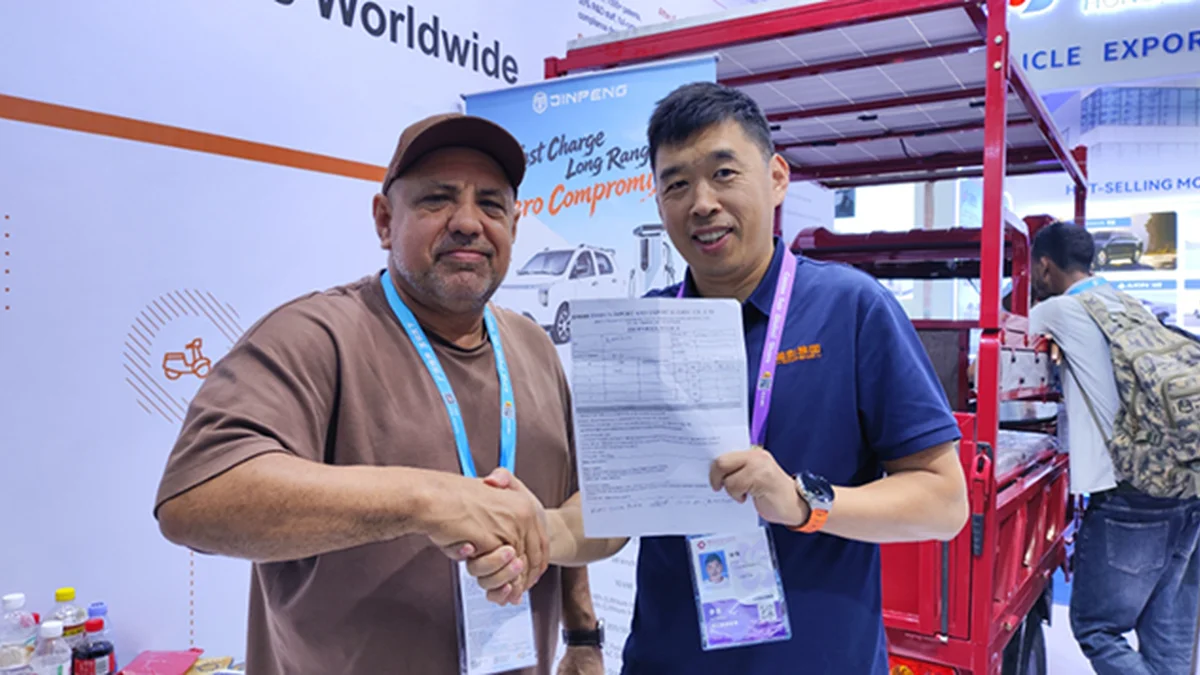
In October 2026, Jinpeng displayed an export lineup at the 140th China Import and Export Fair (Canton Fair) spanning compact four-wheelers, electric motorcycles, and two distinct electric-tricycle formats: the SHK solar passenger-cargo dual-use electric tricycle and the ZEKO-II S long-range passenger electric tricycle. Visiting distributors from South America—including returning Bolivian partners—and East African buyers from Ethiopia reviewed the vehicles on the exhibition floor, with visiting teams scheduling follow-up factory inspections at Jinpeng headquarters.
A trade-fair floor compresses several very different commercial roles into one booth. Seeing a solar-roofed dual-use cargo model beside a dedicated passenger vehicle can make a broad container mix look effortless. For an overseas dealer, however, turning exhibition interest into profitable local inventory requires separating booth curiosity from repeatable demand before fixing quantities or wiring a deposit.
Separate dual-use utility from dedicated passenger stock
Consider a regional distributor in an Andean market town or a fast-growing East African corridor returning from an October trade show. Local walk-in buyers often ask for one vehicle that can carry produce in the morning and passengers in the afternoon. Dual-use configurations such as a canopy-equipped cargo-passenger trike look attractive because they seem to hedge both bets.
In practice, dual-use and dedicated passenger units sell to different customers and carry different support expectations:
- Dual-use cargo-passenger units attract small merchants, rural traders, and family operators who prioritize bed utility, step-in durability, and flexible charging access over cabin finish.
- Dedicated passenger tricycles attract shuttle operators, neighborhood taxi drivers, and commuters who judge the vehicle on seating layout, boarding ease, weather protection, and daily range stability.
- Solar-assisted roofs add hardware to inspect, wire, pack, and replace. Whether supplemental rooftop charging meaningfully helps a local shift depends on daily parking exposure, roof clearance, dust or hail conditions, and the actual controller and battery pairing quoted for that destination.
Treating both categories as interchangeable dilutes dealer messaging. Before asking for container loading plans, write down which customer segment pays fastest in your territory and let that segment anchor the primary share of the shipment.
Use a post-fair headquarters visit to lock the order file
Trade-show brochures and floor samples rarely match the final export specification line by line. When a dealer moves from a Canton Fair booth conversation to a headquarters or factory visit, the visit should close open commercial and technical questions rather than repeat the booth tour.
Bring a structured verification table to the factory floor and record each answer against the exact quoted model code:
| Check area | What to confirm during the visit | Why it protects dealer stock |
|---|---|---|
| Quoted vs. display build | Confirm whether the quoted SHK or passenger variant matches the booth unit in chassis, axle, brake type, canopy frame, and tires | Prevents surprise trim or hardware differences on arrival |
| Energy and charging setup | Verify battery chemistry option, charger input voltage/plug standard, and whether solar panels are standard, optional, or omitted | Stops mismatches with local grid standards and service skills |
| Packing and CKD/SKD scope | Review how solar canopies, roofs, windshields, and seats are crated to avoid glass or panel breakage in sea transit | Protects landed margin on fragile upper-body components |
| Spare-parts kit alignment | Separate shared wear parts (brakes, tires, cables, controllers) from model-exclusive body or roof parts | Keeps slow-moving unique parts from tying up working capital |
| Destination document scope | List what commercial invoice, packing list, VIN/motor serial records, and technical sheets are needed for customs and local checks | Clarifies responsibility before production starts |
Keep unanswered items visibly marked as open. Local road registration rules, passenger-carrying permits, battery import paperwork, and warranty obligations vary by destination and must be verified with local authorities and customs brokers rather than assumed from an export exhibition display.
Distinguish a first container from a returning dealer's expansion
The Canton Fair conversations highlight an important split in dealer readiness: first-time importers building an initial channel face a completely different risk profile from returning regional partners adding an upgraded model to an existing network.
For a first-time distributor, discipline beats variety. Anchor the majority of container slots in one core cargo or dual-use configuration backed by local route checks, and limit any secondary passenger or solar-equipped model to a small validation allocation. Staff should be able to explain, assemble, charge, and service every configuration unloaded from the first container. The Jinpeng product catalog and the mixed cargo and passenger shipment checklist can help structure that opening split without overcomplicating inventory.
For a returning distributor expanding an established territory, new fair-season models earn space only when existing sales and service records show a specific gap—such as customers asking for longer passenger shifts or shaded dual-use seating that current cargo stock cannot satisfy. Pilot the new variant alongside proven replenishment units rather than replacing the core seller overnight.
Tie every new configuration to a parts and handover plan
Adding a solar roof, a long-range passenger pack, or an updated cabin trim increases the number of unique parts a dealer workshop must carry. Before signing off on a post-fair shipment, pair the vehicle purchase order with a matched first-wave parts list covering controllers, chargers, switches, brake components, glazing, and canopy hardware. Reviewing the spare-parts and after-sales plan before production locks in prevents display units from sitting idle while a single specialized component is air-freighted later.
A major international trade fair is valuable because it lets buyers inspect multiple electric-tricycle formats side by side and begin direct factory discussions. Turning that showcase into healthy local inventory still comes down to dealer fundamentals: pick one primary stock role, verify the quoted build on the factory floor, protect fragile export assemblies in packing, and scale new variants only after local buyers and workshops confirm the fit.