
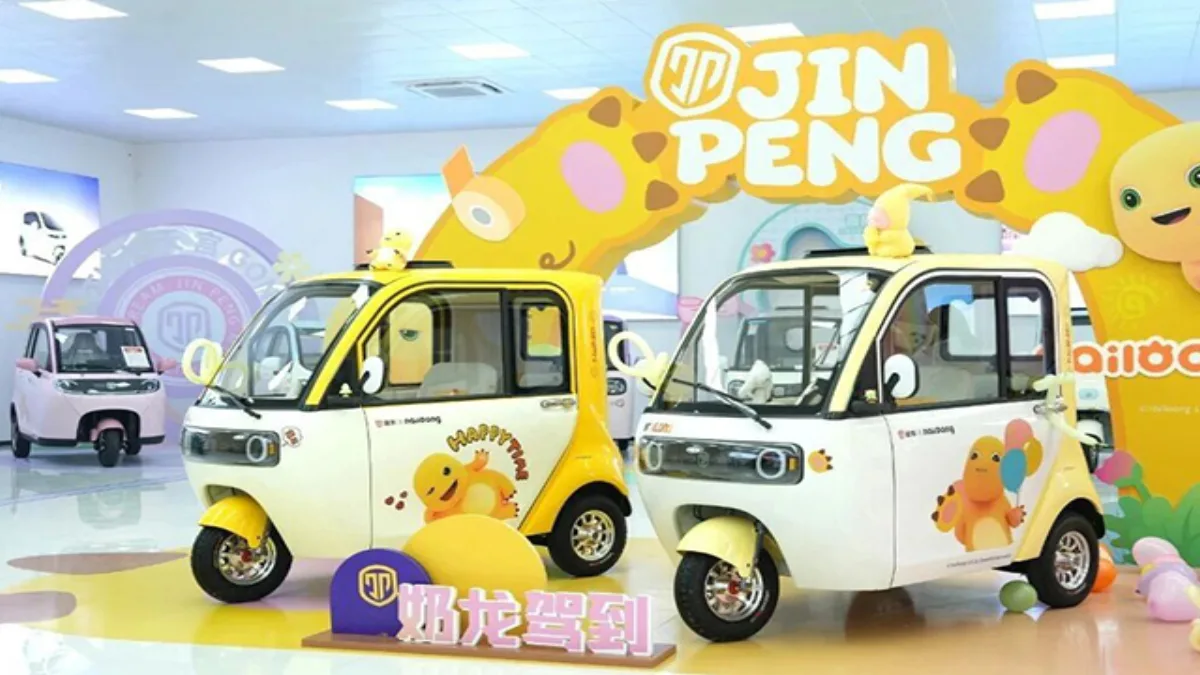
On January 23, 2026, Jinpeng Tricycle announced a character collaboration with Nalong and presented co-branded versions of the Douqi 2.0 Pro and VITA Bloom Edition. The announcement placed these enclosed three-wheel models in family-use contexts such as school trips, shopping, commuting, and outings, supported by themed areas in Jinpeng's domestic retail network.
The VITA Bloom Edition name is an English rendering of the name used in that announcement, not confirmation of a separately available export model. The character graphics, model variants, and merchandising were shown in a domestic program. They do not establish overseas licensing, local availability, homologation, road legality, warranty coverage, or a dealer's right to reproduce the artwork.
For a Southeast Asian peri-urban dealer with several branches, the useful test is therefore narrow: can one distinctive enclosed display unit turn attention into qualified, supportable demand? A co-branded display should begin as a measured showroom experiment, not as a reason to buy deep inventory.
Give one display unit a defined job
Choose one branch, one display period, and one staff owner. Before the unit arrives, write down the decision it must inform: reorder the licensed edition, request a neutral enclosed trim, continue with one display unit, or stop. A test without those choices can collect activity but still leave the stock decision unclear.
Staff should tag each conversation by the visitor's intended household use, usual route, parking situation, shelter expectations, charging questions, service concerns, and purchase timing. A photograph, a social reaction, or a long showroom pause counts as interest, not demand. A qualified inquiry includes a plausible use, a request for current configuration or price information, and a next action the dealer can follow.
The dealer can compare this experiment with the stock roles in its mixed-container checklist. The co-branded unit should not displace a core utility role unless the recorded evidence supports that change.
Put territorial rights before promotion
Before importing or advertising a licensed edition, obtain written answers for the destination and proposed sales period. The file should identify who authorizes the character use, which graphics and model variant are covered, which sales channels and territories are included, and whether local online advertising, showroom materials, events, or replacement panels are permitted.
The same gate applies to the event image shown above: it preserves the Jinpeng and Nalong showroom context and is evidence of the January event only. It is not a reusable merchandising pack or evidence that character rights travel with a vehicle.
Request current photos of the quoted configuration, approved artwork files where applicable, panel and decal replacement terms, parts support, manuals, and warranty boundaries. If those items cannot be confirmed for the destination, test a neutral enclosed trim instead of assuming the domestic collaboration can be reproduced.
Measure what happens after the first look
Use a weekly branch record with a small set of comparable fields:
- Qualified household-use inquiries and their stated routes.
- Follow-up visits, configuration requests, and quotation requests.
- Requests for the same licensed graphics versus a neutral trim.
- Charging, service, parts, and warranty questions staff could not answer.
- Reasons a prospect did not proceed, recorded without sales interpretation.
- Time the unit remains unsold and the working capital tied to it.
The record should separate branches. A location near schools and family retail may produce a different response from a utility-led branch. Moving the same display unit between branches can be more informative than ordering several units before the first test is understood.
The dealer starter-pack framework can keep the display test connected to the broader inventory plan rather than treating visual novelty as a separate buying strategy.
Include service readiness in the reorder gate
A second order creates obligations beyond finding another buyer. Confirm that staff can explain the current configuration, that routine service questions have an owner, and that visible co-branded panels or decals can be repaired or replaced under the agreed rights. Keep component, trim, and artwork changes in one dated file so a later unit is not presented as identical when it is not.
Use the after-sales planning guide to link the proposed reorder to parts, training, escalation, and customer communication. If the unit attracts inquiries but the rights or support path remains uncertain, continuing one controlled display may be the better decision.
Choose the second order explicitly
At the end of the test, compare qualified inquiries, follow-up behavior, neutral-trim requests, service readiness, rights documentation, and slow-stock exposure. Reorder the licensed edition only when demand and territorial permission are both clear. Choose a neutral enclosed trim when the household use is credible but character demand or rights are not. Retain one display unit when it still has learning value, or stop when attention does not progress to supportable demand.
The January collaboration shows how a distinctive display can start a conversation. The dealer's own evidence must decide whether that conversation deserves a second order.