
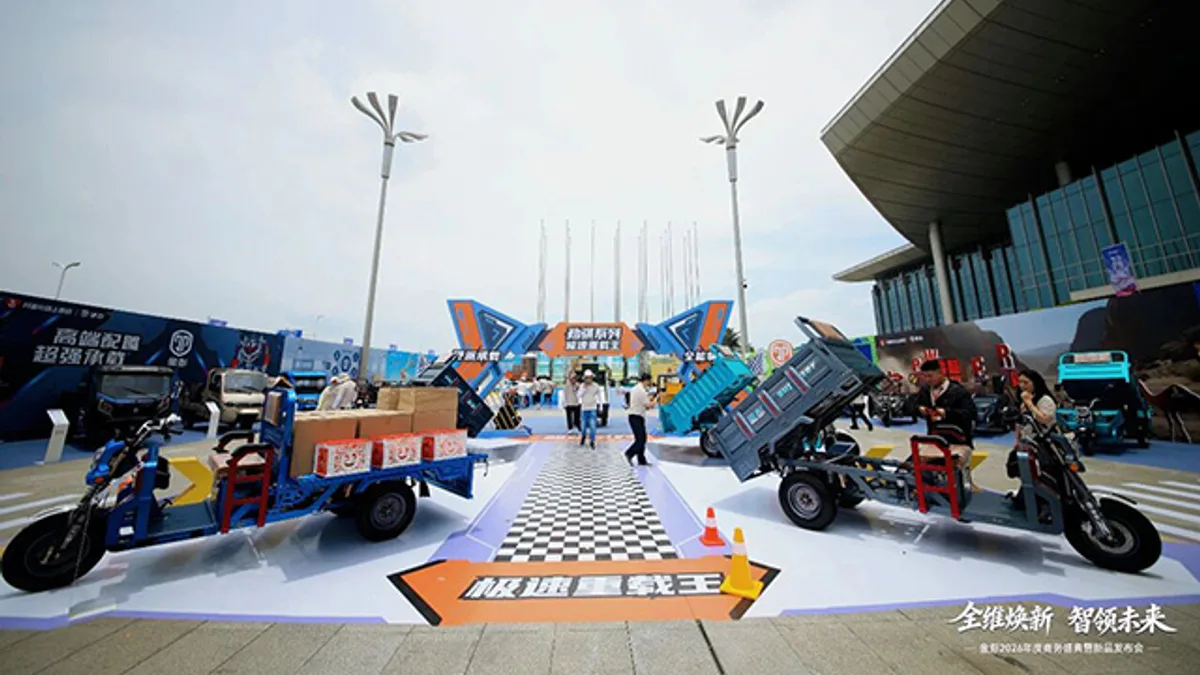
From May 26 to 29, 2026, Jinpeng held its 2026 Business Summit and New Product Launch at Xiamen International Expo Center. The electric three-wheel presentation separated cargo and passenger-oriented products rather than treating the range as one undifferentiated catalog.
The cargo side named Jinwei 2, Fengren 2 Pro, Zhengyun 3, Yuechi 5, and the Tuyun series. The passenger side included Xuebao 2, Douqi 3 Pro, VITA Nalong Intelligent Dual-camera Edition, and Weini. That breadth is useful market context, but it is not an instruction for an overseas dealer to order every model shown. Availability, configuration, documentation, and local suitability still need to be confirmed for the destination.
A launch matrix is not an order sheet
Consider an East African distributor in a secondary city. Its likely inquiries may span market delivery, farm-to-market work, and a smaller amount of sheltered household mobility. The first decision is not "Which launch model looks newest?" It is "Which stock role answers the most credible local demand?"
The distributor can start by writing three short route profiles:
- A market-delivery route with its normal stops, loading pattern, parking constraints, and return schedule.
- A farm-to-market route with the actual road surfaces, service access, charging location, and goods handled.
- A household-mobility route that records passenger needs, shelter expectations, parking, charging, and who will maintain the vehicle.
These profiles do not prove that a vehicle is suitable. They give the buyer a consistent basis for asking questions and comparing current quotations.
Give every stock role one clear job
A controlled opening mix can use three roles without turning the shipment into a showroom of unrelated choices.
Core cargo role. This is the configuration matched to the strongest repeat use case. It should receive most of the buyer's validation effort: route observations, body-format questions, service planning, and dealer training.
Adjacent alternative. This is not a second core model. It should answer one clear difference, such as an alternative body format, shelter requirement, or buyer budget. If staff cannot explain that difference in one sentence, the alternative is probably adding complexity rather than coverage.
Passenger or display role. At most one role should test whether enclosed household mobility creates qualified inquiries. A display vehicle can broaden the conversation, but attention alone is not evidence for deep stock.
The current Jinpeng product range can help a buyer organize those roles. Exact model codes, quantities, colors, and energy configurations should remain provisional until the destination checks and current commercial file are complete.
Build the evidence file before fixing quantities
For each shortlisted role, request one current comparison file. It should identify the quoted variant, intended destination, body format, energy setup, charger, packing method, replacement-parts proposal, available media, training material, and document scope. Photos or video should show the configuration actually being quoted, not simply repeat an event display.
The buyer should also record what remains unanswered. Registration category, road-use rules, battery and charger requirements, labeling, import documentation, and local service responsibilities vary by destination. They cannot be inferred from a domestic product launch or from a model name.
Keeping these questions together makes changes visible. If a body, battery, charger, trim, or packing detail changes during quotation, the dealer can review the effect on the route role, parts list, and customer explanation before approving it.
Plan the dealer explanation with the stock mix
The Xiamen event also placed attention on store experience, online enquiries, and service. A dealer can turn that message into practical preparation without copying event promotion.
The core cargo role needs a sales sheet built around the local task it is meant to serve. The adjacent alternative needs a short comparison that explains why it exists. The display role needs staff questions that separate curiosity from a usable household scenario. The mixed-container planning guide provides a useful handoff for aligning product names, shipment records, dealer training, and local support material.
Prepare the explanation from the final quoted configuration. Do not circulate unconfirmed specifications or describe a launch model as locally available before the shipment is agreed.
Decide the second order from observed demand
The first shipment should create evidence for a cleaner reorder. Dealers can tag inquiries by route, body preference, charging question, service concern, and requested delivery timing. They can also record which display conversations become a quotation, which alternatives remain slow, and which service questions staff cannot yet answer.
After-sales readiness belongs in the same review. A model that attracts interest but lacks an agreed parts and support path may not deserve more inventory. The spare-parts and after-sales plan can help connect each stock role to a first parts kit, service notes, and a clear escalation process.
The result is a deliberate dealer stock mix rather than a miniature copy of a launch floor: one cargo role supported by the strongest local evidence, one purposeful alternative, and no more passenger/display inventory than the dealer can explain and support. The launch supplies the range of possibilities. Local routes, current files, and observed demand decide what belongs in the order.